Named configurations
1 Defining configurations for a Plugin
2 Accessing configuration properties for a named configuration
3 Deserializing and serializing a named configuration
3.1 Without accessing configuration properties by name
4 See also
2 Accessing configuration properties for a named configuration
3 Deserializing and serializing a named configuration
3.1 Without accessing configuration properties by name
4 See also
In some cases it can be useful to specify a named configuration for a Plugin.
This can be useful if you want to share a configuration between several Plugins. In that case you will have only one set of properties associated with a configuration name, and you can refer to this same configuration for more than one Plugin.
The
It is better to access configuration properties by their names (for setting or getting their values) for a name configuration.
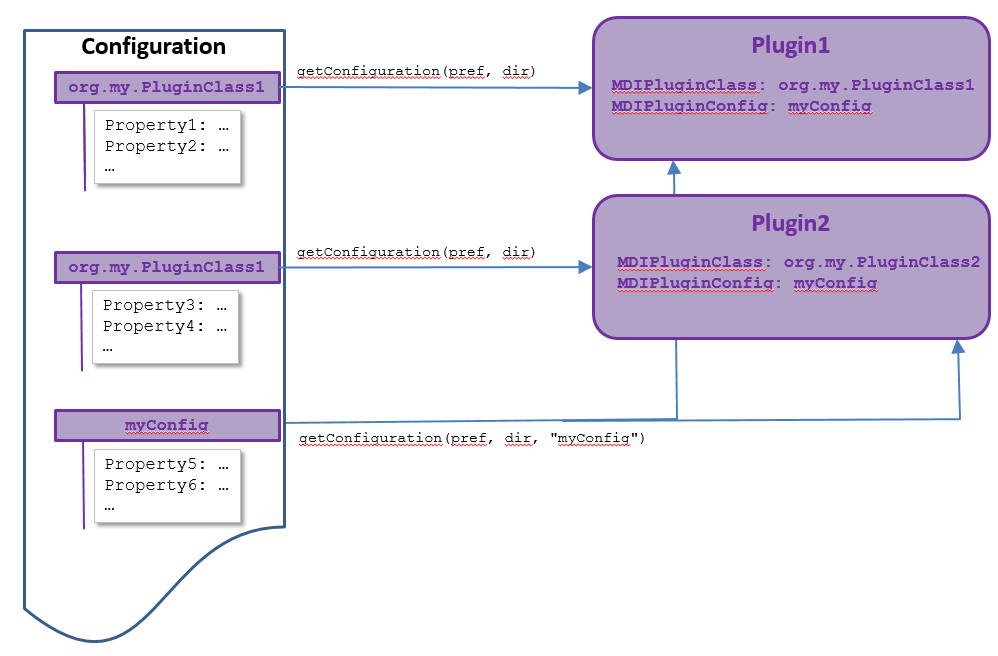
This can be useful if you want to share a configuration between several Plugins. In that case you will have only one set of properties associated with a configuration name, and you can refer to this same configuration for more than one Plugin.
Defining configurations for a Plugin
Main Article: Plugin Manifest
The
MDIPluginConfig manifest property allows to specify the configuration or configurations associated with the Plugin. For example:MDIPluginClass: my.plugin.MyPluginClass MDIPluginConfig: myConfigIt is also possible to define more than one configuration for a Plugin (configurations must be separated by a semicolon). For example:
MDIPluginClass: my.plugin.MyPluginClass MDIPluginConfig: myConfig;myConfig2
Accessing configuration properties for a named configuration
Main Article: Accessing configuration properties by name
It is better to access configuration properties by their names (for setting or getting their values) for a name configuration.
Deserializing and serializing a named configuration
There are two ways to deserialize and serialize a named configuration:- If you did not access properties by their names, you must use the
getConfigurationandputConfigurationmethods with the configuration name - Else if you access properties by their names, you won't need to implement these methods, because the framework will do it for you
Without accessing configuration properties by name
The Configuration associated with the Plugin can be deserialized or serialized for each named configuration associated by the methods used for the configuration:- The NamedConfiguration.getConfiguration(Preferences pref, File dir, String config) method, called when serializing the configuration. It is expected that the Configuration will use the various
putmethods in the Preferences class for each named configuration in the Plugin - The NamedConfiguration.putConfiguration(Preferences pref, File dir, String config) method, called when serializing the configuration. It is expected that the Configuration will use the various
getmethods in the Preferences class for each named configuration in the Plugin
See also
- Configuration: This article is about the configuration management
- Named configuration tutorial: This tutorial explains how to use a named configuration
- Plugins: This article is about Plugins
Categories: Conf
